使用 Amazon SageMaker JumpStart 部署并评估模型
Deploy and evaluate models with Amazon SageMaker JumpStart
Amazon SageMaker JumpStart 提供预训练模型目录,可通过 SageMaker Python SDK 部署模型、运行可重复的性能测试并删除 endpoint。
为特定应用选择合适的模型,需要一种实用的方法来使用具有代表性的输入对其进行测试。Amazon SageMaker JumpStart 提供了对广泛的预训练模型目录的访问。在这篇文章中,我们将展示如何从 SageMaker JumpStart 部署一个可用模型,使用 SageMaker Python SDK 运行轻量且可重复的性能测试,并在测试完成后删除终端节点。对于受支持的模型和可用容量,该工作流提供了一条可重复的评估路径,不过部署时间会因模型、实例类型、配额和 AWS 区域而异。
在 2026 年,SageMaker JumpStart 推出了两项改进,简化了模型的发现和部署。在 Amazon SageMaker AI 控制台的 Model Hub 部分,您可以浏览 SageMaker JumpStart 目录、查看示例笔记本,并直接在 SageMaker Studio 中打开它们。预配置的终端节点部署选项提供了一系列命名的配置,针对低成本、低延迟或通用工作负载等优先级进行了优化,涵盖多种生成式 AI 模型,包括针对 Neuron 优化的配置。此外,现在您可以通过新的深层链接集成,一键完成从 Hugging Face 模型发现到 SageMaker AI 部署的全过程。
解决方案概览
我们的方法使用一个可重用的 Python 脚本,执行三个步骤:
- 从 SageMaker JumpStart 发现并部署模型。
- 运行模型特定的示例提示词,并测量延迟、近似输出长度和单请求生成速率。
- 清理终端节点。
这一模式适用于许多兼容的 SageMaker JumpStart 模型,不过负载格式、所需的实例类型、最终用户许可协议(EULA)要求以及响应模式可能需要针对模型进行特定调整。
前提条件
- 拥有 SageMaker AI 权限的 AWS 账户。
- Python 3+ 并安装了 SageMaker Python SDK v3(
pip install "sagemaker>=3,<4")。 - 足够的 GPU 实例配额用于您想测试的模型,或申请提升配额。
步骤 1.a:发现可用模型
在 SageMaker JumpStart 中查找模型的 UI 路径:
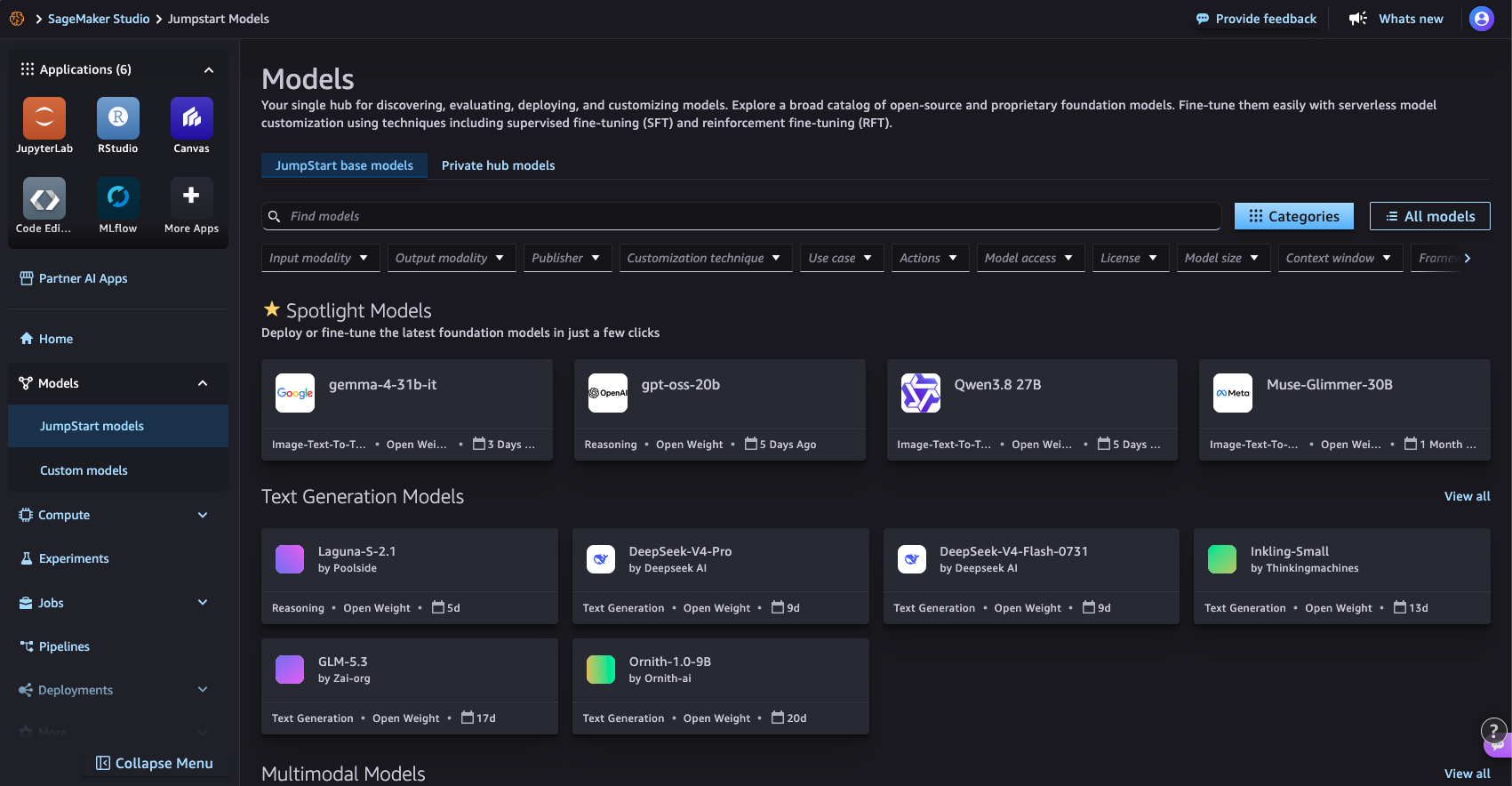
图 1:在 SageMaker Studio 的 SageMaker JumpStart Models 页面上浏览模型目录
使用 SageMaker Python SDK 的代码路径:
from sagemaker.core.jumpstart.notebook_utils import (
    list_jumpstart_models,
)

REGION = "us-east-1"

models = list_jumpstart_models(
    filter="task == textgeneration",
    region=REGION,
    list_versions=True,
)

print(f"Found {len(models)} text generation models")

for model_id, model_version in models[:10]:
    print(
        f" - {model_id} "
        f"(version {model_version})"
    )
或按模型名称搜索:
from sagemaker.core.jumpstart.notebook_utils import list_jumpstart_models

ids = list_jumpstart_models(
    filter="model_id contains qwen",
    region=REGION,
    list_versions=True,
)

print(f"{len(ids)} models matched in {REGION}\n")

for model_id, version in ids:
    print(f"{model_id:<55} v{version}")
步骤 1.b:部署模型
从 SageMaker JumpStart 部署模型的 UI 路径:
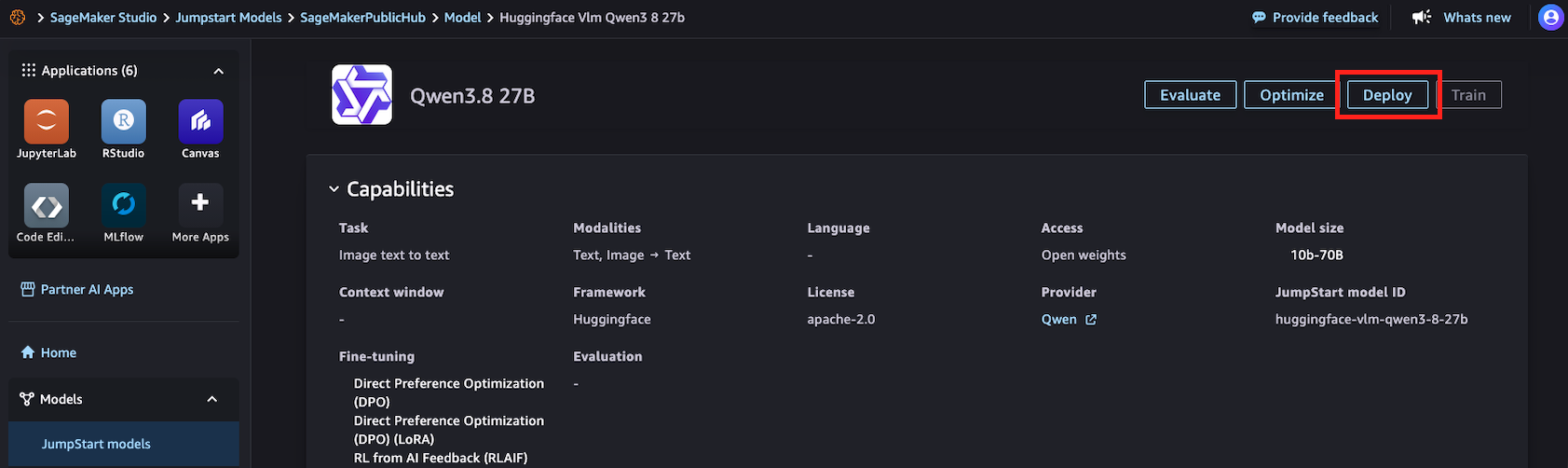
图 2:在 SageMaker Studio 中从模型的 SageMaker JumpStart 详情页面部署模型
使用 SageMaker Python SDK 的代码路径:
import time

from sagemaker.core.jumpstart.accessors import JumpStartModelsAccessor
from sagemaker.core.jumpstart.configs import JumpStartConfig
from sagemaker.core.training.configs import Compute
from sagemaker.serve import ModelBuilder

MODEL_ID = "huggingface-vlm-qwen3-5-27b"
MODEL_VERSION = "1.13.0"
REGION = "us-east-1"
ACCEPT_EULA = False  # Set True only after reviewing the model terms

def get_field(value, name, default=None):
    if isinstance(value, dict):
        return value.get(name, default)
    return getattr(value, name, default)

# Resolve the JumpStart-recommended deployment configuration.
specs = JumpStartModelsAccessor().get_model_specs(
    region=REGION,
    model_id=MODEL_ID,
    version=MODEL_VERSION,
)

if isinstance(specs, list):
    if not specs:
        raise ValueError(
            f"No JumpStart specification found for {MODEL_ID}"
        )
    specs = specs[0]

recommended_instance_type = get_field(
    specs,
    "default_inference_instance_type",
)

if not recommended_instance_type:
    raise ValueError(
        f"No recommended instance type found for {MODEL_ID}"
    )

print(f"Model: {MODEL_ID}")
print(f"Region: {REGION}")
print(f"Recommended instance: {recommended_instance_type}")

start = time.time()

jumpstart_config = JumpStartConfig(
    model_id=MODEL_ID,
    model_version=MODEL_VERSION,
    accept_eula=ACCEPT_EULA,
)

model_builder = ModelBuilder.from_jumpstart_config(
    jumpstart_config=jumpstart_config,
    compute=Compute(
        instance_type=recommended_instance_type,
        instance_count=1,
    ),
)

model = model_builder.build()
endpoint = model_builder.deploy()
deploy_time = time.time() - start

print(f"Deployed in {deploy_time:.1f} seconds")
print(f"Endpoint: {endpoint.endpoint_name}")
步骤 2:运行示例提示词并测量性能
from sagemaker.core.payloads import retrieve_all_examples
import json
import time

MODEL_ID = "huggingface-vlm-qwen3-5-27b"
MODEL_VERSION = "1.13.0"
REGION = "us-east-1"

example_payloads = retrieve_all_examples(
    region=REGION,
    model_id=MODEL_ID,
    model_version=MODEL_VERSION,
    serialize=True,
)

#you can re-create the endpoint pointer using the endpoint name:
#from sagemaker.core.resources import Endpoint
#endpoint = Endpoint.get(endpoint_name="<your_endpoint_name>",region=REGION)

def read_response_body(result):
    body = result.body
    if hasattr(body, "read"):
        body = body.read()
    if isinstance(body, bytes):
        body = body.decode("utf-8")
    if isinstance(body, str):
        try:
            return json.loads(body)
        except json.JSONDecodeError:
            return body
    return body

def extract_output(response):
    """Handle common JumpStart text-generation response formats."""
    if isinstance(response, list):
        response = response[0] if response else ""
    if isinstance(response, dict):
        choices = response.get("choices")
        if choices:
            choice = choices[0]
            message = choice.get("message")
            if isinstance(message, dict):
                return message.get("content", "")
            return choice.get("text", "")
        for field in (
            "generated_text",
            "output_text",
            "text",
        ):
            if field in response:
                return response[field]
    return response

results = []

for payload in example_payloads or []:
    start = time.perf_counter()
    result = endpoint.invoke(
        body=payload.body,
        content_type=payload.content_type,
        accept=payload.accept,
    )
    latency = time.perf_counter() - start
    response = read_response_body(result)
    output = extract_output(response)
    if not isinstance(output, str):
        output = json.dumps(output, indent=2)
    # This is an estimate based on whitespace-separated words.
    output_words = len(output.split())
    results.append(
        {
            "request_preview": payload.body[:50],
            "latency_s": round(latency, 2),
            "estimated_output_words": output_words,
            "words_per_second": round(
                output_words / latency,
                1,
            ) if latency > 0 else 0,
        }
    )
    print("Input:\n", payload.body, end="\n\n")
    print("Output:\n", output, end="\n\n")
    print(
        f"Latency: {latency:.2f} seconds\n"
        f"Estimated output words: {output_words}\n"
        f"Estimated single-request output generation rate: "
        f"{output_words / latency:.1f} words/second\n"
    )
    print("-" * 80)

print("\nSummary:")
for result in results:
    print(result)
结果:
Input:
{"max_tokens": 256, "messages": [{"content": "What is deep learning?", "role": "user"}], "model": "/opt/ml/model"}
Output:
Here's a thinking process that leads to the explanation of deep learning:
1. **Deconstruct the Request:**
* **Question:** "What is deep learning?"
* **Intent:** The user wants a clear, comprehensive, yet accessible definition and overview of deep learning.
* **Target Audience:** Likely someone looking for a general understanding, possibly a student, tech
enthusiast, or professional exploring the field. The tone should be informative, structured, and
not overly jargon-heavy (though key terms need explanation).
2. **Initial Brainstorming & Key Concepts:**
* What is it? A subset of machine learning, which is a subset of AI.
* Core mechanism: Artificial Neural Networks (ANNs).
* "Deep" means many layers (hidden layers).
* How does it work? Learning representations from data (feature learning).
* Key applications: Image recognition, NLP, speech, self-driving cars.
* Why is it popular now? Big data, GPU power, better algorithms.
* Pros/Cons: High accuracy vs. black box, data hunger.
3. **Structuring the Answer:**
Latency: 9.07 seconds
Estimated output words: 153
Estimated single-request output generation rate: 16.9 words/second
--------------------------------------------------------------------------------
Summary:
{'request_preview': '{"max_tokens": 256, "messages": {"content": "What', 'latency_s': 9.07, 'estimated_output_words': 153, 'words_per_second': 16.9}
步骤 3:清理
print(f"Deleting endpoint: {endpoint.endpoint_name}")
endpoint.delete()
endpoint.wait_for_delete()
print("Endpoint deleted")
结论
这一模式适用于许多可用的 SageMaker JumpStart 模型,但负载格式、所需的实例类型、EULA 和响应解析可能需要针对模型进行特定调整。通过使用一致的测试提示词并测量各模型的延迟、吞吐量和输出质量,您可以比较不同选项并选择最适合您工作负载的模型。
请尝试对来自 Amazon SageMaker JumpStart 的不同模型使用这一方法,为您的应用找到质量、速度和成本之间的最佳平衡。
参考资料
- SageMaker Python SDK 文档
- 对 SageMaker JumpStart 部署进行基准测试和优化(博客文章)
- 一键从 Hugging Face 到 SageMaker Studio(博客文章)
- Amazon SageMaker JumpStart
关于作者
来源:AWS Machine Learning Blog · aws.amazon.com