AMD to Bring UCIe Connectivity to Select AMD Versal Adaptive SoCs
AMD to Bring UCIe Connectivity to Select AMD Versal Adaptive SoCs
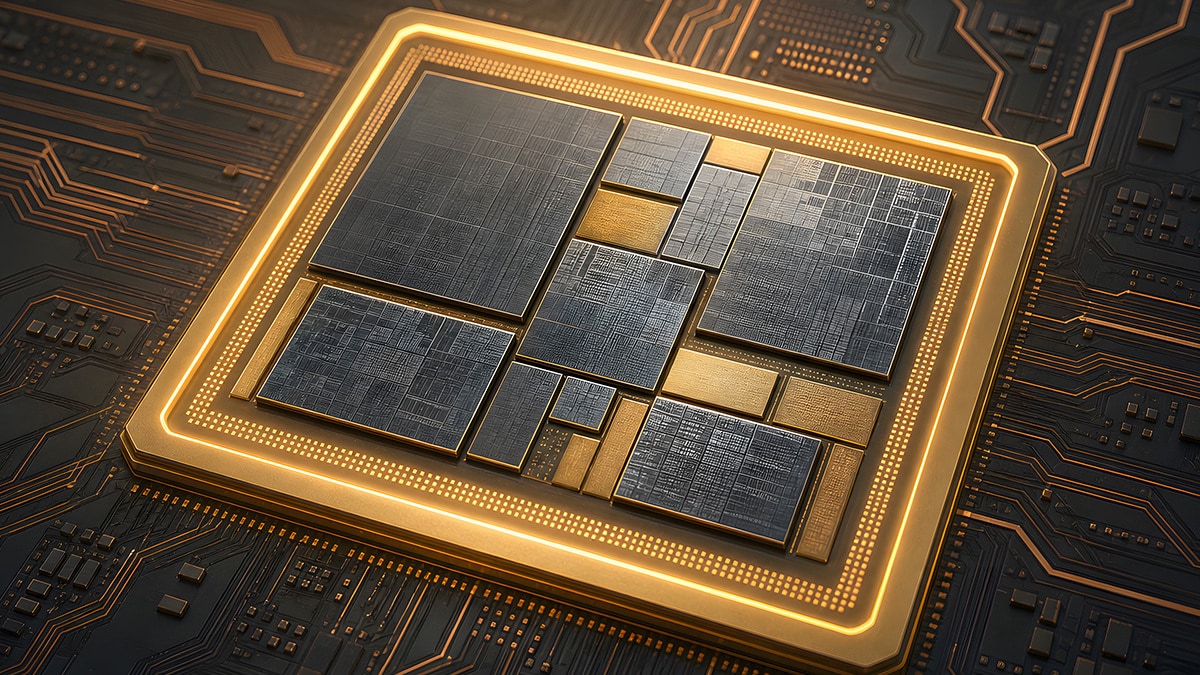
AMD announced it will be first to offer native UCIe 1.1 interface support in Versal adaptive SoCs, enabling low-power, high-bandwidth communication between adaptive SoCs and co-packaged specialty chiplets.
AMD will offer the first Versal adaptive SoCs supporting Universal Chiplet Interconnect Express connectivity, enabling direct communication with co-packaged chiplets built for specialized workloads.
Published August 25, 2026
Terms
Download image
Please read through and acknowledge the Terms & Conditions before downloading.
By downloading and incorporating the AMD Trademarks or AMD Logos and/or images provided herein (collectively, the “AMD Mark(s)”), you are accepting the Terms and Conditions and committing you and your company to the Terms and Conditions. Once the Terms and Conditions are accepted, AMD uses Cookies to enable the user to bypass this screen when downloading AMD brand assets in the future.
The AMD Marks are owned exclusively by Advanced Micro Devices, Inc. ("AMD"), protected under relevant trademark and copyright laws around the world, and are provided on an “as is” basis without warranty of any kind, express or implied, for use subject to the terms of this license (“License”). AMD hereby grants you ("Licensee" or “You” or “Your”) limited permission to use the AMD Mark(s) solely in connection with the advertising, marketing, promotion, and sale of Licensee products that include an AMD CPU, GPU, APU, or FPGA (each an “AMD Processor”) and in accordance with the AMD Corporate and Product Branding Guidelines, which may be modified by AMD from time to time. You agree to ensure that You are in possession of the latest, updated version.
This grant does not extend to use of AMD Mark(s) on Licensee product packaging or use of AMD Mark(s) on any goods that do not contain an AMD Processor. AMD shall remain the exclusive owner of all rights in the AMD Mark(s), and this License does not grant any other rights with respect to AMD’s Mark(s) trademarks or copyright. You agree that You will not, nor will you help others, contest, attack, or dispute AMD’s rights in the AMD Mark(s). The AMD Mark(s) must be used only in a positive manner and shall not be used in any way that may, in AMD’s sole judgement, disparage AMD’s reputation.
You agree not to use the AMD Mark(s) in a manner to suggest AMD’s endorsement or sponsorship of your goods or services, or in any way that may create confusion as to the source of the goods, and Licensee’s company name, logo or product name shall appear on any products or related materials where an AMD Mark(s) is used. This license may be terminated by AMD at any time, and failure to comply with these terms will result in automatic termination of this License.
Sometimes AMD acquires the right(s) to certain image(s) and includes such image(s) within AMD system(s) (“Licensed Images”). You agree to refrain from using Licensed Images for any reason outside of those directly related to your reason for accessing AMD system(s) contemplated under these Terms and Conditions. Additionally, you agree to comply with all limitation(s) on Licensed Images that are communicated to you by AMD, including but not limited to limitation(s) conveyed to you via notes in a file containing the Licensed Images.
If You encounter any non-public information related to AMD (“Confidential Information”) while accessing AMD system(s), You agree to (a) reasonably protect and not disclose any Confidential Information to any third party(ies) without AMD’s written permission; and (b) refrain from using Confidential Information in ways not relating to your access of AMD system(s).
If it is determined by AMD – in its sole opinion - that You have violated these Terms and Conditions or have otherwise misused Confidential Information, Your access to AMD system(s) may be revoked immediately and without notice.
If you have any questions regarding the terms and conditions of this Agreement, please contact the AMD Law Department at [email protected].
What’s the News? AMD will offer the first Versal™ adaptive SoCs with native support for Universal Chiplet Interconnect Express (UCIe®) 1.1 interfaces,1 enabling low-power, high-bandwidth communication between co-packaged AMD adaptive SoCs and specialized chiplets.
Why It Matters? As designers seek greater flexibility, higher performance and faster development cycles, monolithic devices are giving way to modular chiplet-based systems built from specialized silicon components in a single package. UCIe, an open industry standard, allows system designers to combine specialized silicon in a single package instead of redesigning large monolithic SoCs or developing a new SoC for every application. This approach can reduce latency,2 power,3 size, development cost and complexity while accelerating time to market and giving designers greater flexibility to reuse proven silicon IP.
What’s the Role of AMD?
The semiconductor industry is entering a new era where innovation is increasingly driven by chiplet architectures that combine specialized chiplets to meet specific use cases. AMD Versal RF Series chiplets are uniquely positioned to be the starting point to harness UCIe connectivity, bringing heterogeneous compute architecture with up to 80 TOPS of DSP compute, integrated RF converters and SWAP-C benefits to customers and unlocking the next generation of adaptive RF systems.
What Do Versal RF Devices Support? AMD Versal™ RF Series devices will be the first Versal adaptive SoCs to enable UCIe 1.1 connectivity. They will support up to four independent UCIe-SP (standard-package) interfaces and up to two UCIe-AP (advanced-package) interfaces, providing multi-terabit per second aggregate in-package bandwidth. Additional AMD adaptive SoCs with UCIe support will be added as the market matures.
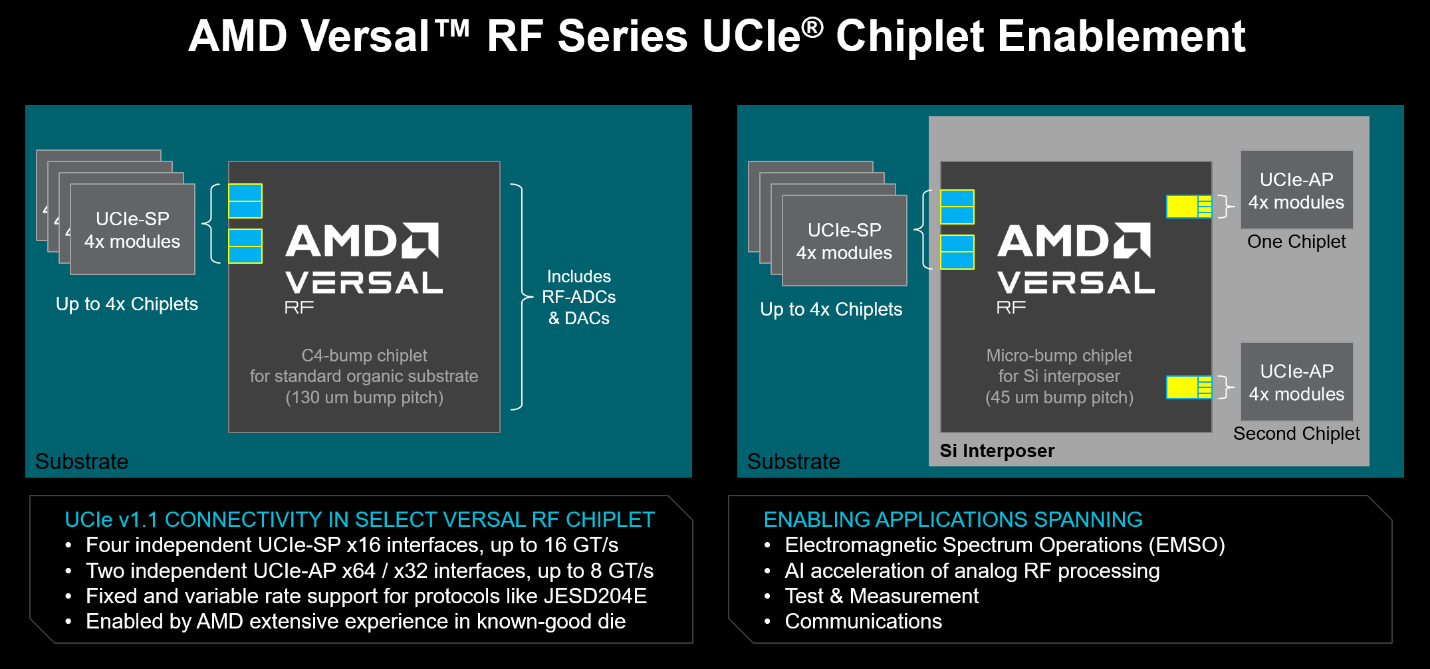
What Makes Versal RF Series Devices Unique? Versal RF Series adaptive SoCs integrate high-resolution RF data converters, dedicated hard intellectual property (IP) for DSP, AI Engines and programmable logic in a single-chip device. They offer up to 80 TOPS (trillion operations per second) of heterogeneous DSP compute and significant SWAP-C (size, weight, power and cost) benefits by combining the functionality of six devices into a single package.
Adding UCIe connectivity will expand these capabilities significantly by allowing Versal RF Series chiplets to communicate directly with co-packaged chiplets optimized for specific workloads, such as:
Third-party RF AFEs or data converters
AI acceleration chiplets
CPUs
GPU specialized compute
Custom security engines
Communications processors
Application-specific ASICs
What Changes with Chiplets? Chiplets move specialized functions closer together. Historically, integrating RF front ends, AI accelerators, optical interfaces, memory subsystems or custom ASICs required board-level connections that can add latency, power consumption, size and design complexity. UCIe provides a standardized in-package interconnect, enabling efficient communication between heterogeneous chiplets, including silicon from different vendors.
Benefits of UCIe will enable customers to build customized systems leveraging existing, proven chiplets, eliminating time and helping lower the cost to redesign large monolithic SoCs. These benefits include:
High-bandwidth chiplet-to-chiplet communication
Reduced latency and improved power efficiency compared to AMD devices with board-level GTM2 serialized interfaces2 3
Reuse of proven silicon IP
Potential for lower development costs
Faster time to market
Design flexibility through chiplet integration
What’s Next? The introduction of UCIe connectivity for select Versal RF Series adaptive SoCs transforms the device into a scalable chiplet platform capable of serving a broad range of next-generation RF, AI, networking and communications applications and enables SWAP-C reduction.
Production chiplets are expected to be available with select Versal RF Series devices in the fourth quarter of 2027.
© 2026 Advanced Micro Devices, Inc. All rights reserved. AMD, the AMD Arrow logo, Versal, and combinations thereof are trademarks of Advanced Micro Devices, Inc. UCIe and Universal Chiplet Interconnect Express are trademarks of Universal Chiplet Interconnect Express, Inc. Other product names used in this publication are for identification purposes only and may be trademarks of their respective owners. Certain AMD technologies may require third-party enablement or activation. Supported features may vary by operating system. Please confirm with the system manufacturer for specific features. No technology or product can be completely secure.
-
Based on AMD internal analysis. Select AMD Versal RF adaptive SoCs with support for UCIe 1.1 interfaces, as of August 2026. (VER-114)
-
Select AMD Versal RF adaptive SoCs with support for UCIe 1.1 specification offer lower latency than AMD adaptive SoCs with support for board-level GTM2 serialized interfaces. (VER-115)
-
Based on AMD internal analysis, comparing the estimated energy efficiency for select Versal RF Series adaptive SoCs with UCIe 1.1. SP and AP interface support, defined as the energy consumed in (pJ/bit) to traverse from FDI to bump and back to FDI, with all the adapter and physical layer-related circuitry including, but not limited to, Tx, Rx, PLL, clock distribution, etc., versus the estimated energy per bit consumed by AMD adaptive SoCs, with support for board-level GTM2 serialized interfaces. (VER-116)
Share / cite
More from this category
-

Embedded October 1, 2026
AMD Sampling Versal AI Core Adaptive SoC in Enhanced Space-Grade Package for the Most Demanding Missions
New package will be Class Y qualified for the highest level of reliability assurance, and is specifically designed for extended space missions lasting up to 15 years.
-

Embedded September 30, 2026
AMD Brings the Power of Agentic AI to Embedded Design and Development Cycle
AMD Ross agentic AI assistant spans software, silicon and board design to dramatically accelerate embedded system design, optimization, debug and deployment compared to typical development life cycles.
-

Embedded September 21, 2026
Media Alert: AMD to Showcase Physical AI and Robotics Innovation at ROSCon 2026
AMD will show how high-performance compute and open software can help developers train, simulate and deploy intelligent robotic systems from the cloud to the edge.
-

Embedded July 23, 2026
AAI 2026: AMD Delivers Leadership Heterogeneous Compute for Physical AI
AMD extends the Ryzen AI Embedded processor family combining CPU, GPU and NPU acceleration to power robotics, industrial automation and intelligent embedded systems.
Source: AMD Chips and Compute · newsroom.amd.com