AI Is the New Electricity. And the Meter Is Running.
AI Is the New Electricity. And the Meter Is Running.
At its 2026 Agentic AI Exchange conference, AMD argued that the key to enterprise AI is not how much compute you have, but the business value generated per token. AMD said its end-to-end AI product portfolio, open platform, and ecosystem partnerships help enterprises match workloads to the right compute across cloud, data center, edge, and AI PC, and laid out a three-step framework: identify needs, validate value, and accelerate scale-out.
AI is the new electricity. Just as electricity gave the world power, AI gives the world intelligence. And much like electricity transformed how we live and work, AI is becoming part of our everyday lives, changing how we connect, create, play and do business. It's putting the power to innovate at extraordinary scale into more people’s hands than ever before.
That was a central theme at this year’s Agentic AI Exchange in New York City, where business and technology leaders came together to discuss how enterprises can move beyond experimentation and put agentic AI to work at scale.
But there’s a second half to that idea, and it’s the one I hear about most from CIOs: The meter is running. And it leads to two questions: How quickly can you put AI to work? And how much business value can you generate for every token you spend?
Answering those questions is where we can help. At AMD, we're working with customers to turn AI into business solution outcomes. With our leadership end-to-end AI portfolio, open platforms and deep ecosystem partnerships, we create the flexibility to run AI wherever it delivers the greatest value.
For AI, Four Leaps in Four years
The pace of change has been remarkable. In 2022, AI became conversational. In 2023, it became multimodal. In 2024, it began reasoning. In 2025, it became agentic — a shift that continues accelerating through 2026.
That last step is particularly significant for enterprises. A personal agent can make one person more productive. A team of agents can multiply what an entire function delivers. And intelligent agents working across business processes can positively transform how organizations operate.
Every Productivity Multiplier Is a Compute Multiplier
As AI agents become more capable, they require more reasoning, provide more context and take more actions, all while costing more tokens. Multiply that across thousands of enterprise workflows, and the demand and cost for compute grows dramatically.
For CIOs, the imperative is clear: scale AI without scaling costs at the same rate.
That means thinking strategically about how and where AI workloads run and choosing infrastructure that delivers the greatest value.
The Right AI Workload on the Right Compute
Enterprise customers have consistently shared that there's no one-size-fits-all approach to AI.
Not every workload requires a large frontier model in the cloud. Many can run more efficiently on smaller, specialized or open-weight models across cloud, data center, edge and AI PCs.
The key is to match each workload to the right model and compute while balancing performance, cost and security.
We’re already seeing the business impact of this approach. AT&T, one of the world's largest telecommunications providers, has processed more than 1 trillion tokens on AMD Instinct™ GPUs in Microsoft Azure to train open telco-specific models, and its cache-aware AI gateway, which routes each task to the right model, has reduced AI costs by as much as 80%.1
That’s a powerful example of how the right infrastructure strategy can help enterprises scale AI while managing costs. Running workloads locally, on premises or on AI PCs can also reduce latency and keep sensitive data closer to home.
The goal isn’t simply more compute. It's greater business value from every workload.
A Framework for Turning AI into Business Value
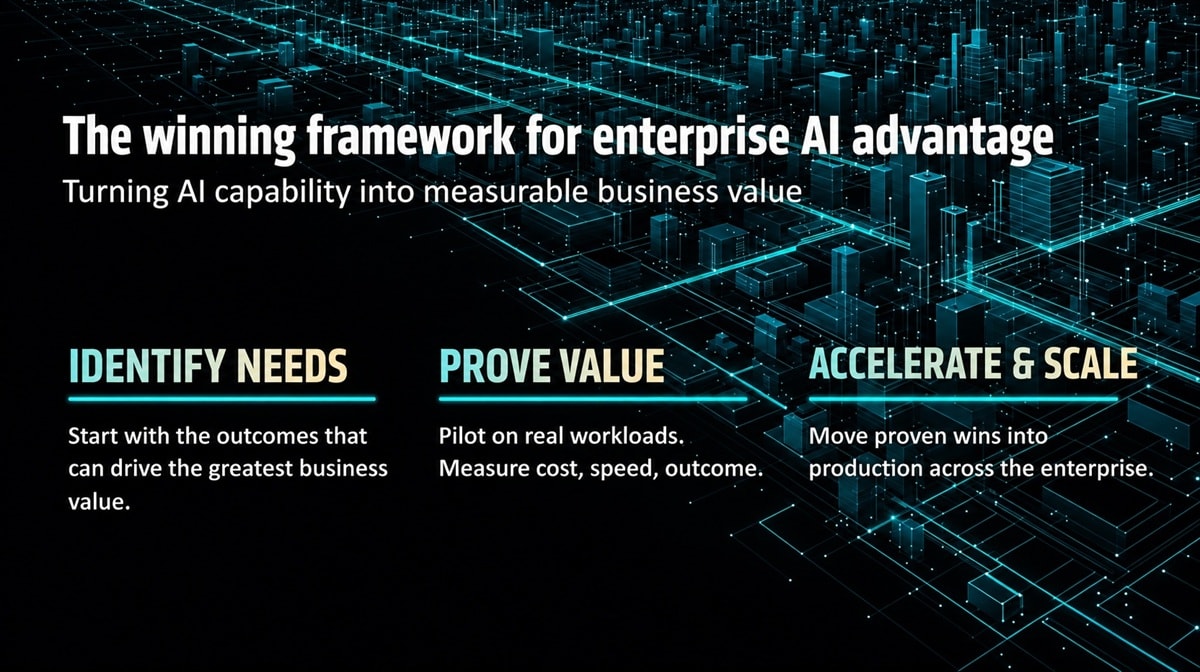
When customers ask where to start, I share a simple three-step framework:
1. Identify Needs: Start with the business outcomes that matter most, whether those are boosting productivity, reducing costs or improving customer experiences. Next, pinpoint the key workflows that drive those outcomes and the ones you want to optimize. Then, design the agentic workflows themselves: decide which tasks agents will take on, where people stay in the loop and how agents will connect to your data and systems. Finally, match each workload to the right compute and model so every agent runs on the right solution for the job.
2. Prove Value: Test before you invest. Use real-world proofs of concept and total cost of ownership modeling to establish a baseline, measure return on investment and validate the business case before scaling.
3. Accelerate and Scale: Once you’ve proven the business case, focus on replicating what works. With the right infrastructure, governance and operational support, enterprises can move from individual pilots to production-ready solutions that deliver consistent, measurable value across the business.
The Bottom Line
We’re at an extraordinary moment in the evolution of AI. While AI capability is fundamental, what is essential is turning that AI capability into tangible business value.
A century ago, the winners weren’t the ones who used the most electricity. They were the ones who were best at putting it to work. The same will be true for AI: The meter is running, and value per token is the new measure of success.
Enterprises that lead will be those that make smart infrastructure decisions, prove value early and scale what works.
Source: AMD Chips and Compute · newsroom.amd.com